Get Online consultation with 3 Easy Process
- Pay Consultation Fee (RS.1000) by using QR Code
- Send payment screenshot on whats app: +91 9910873175
- After Verifying Your Payment, We Will connect you with doctor

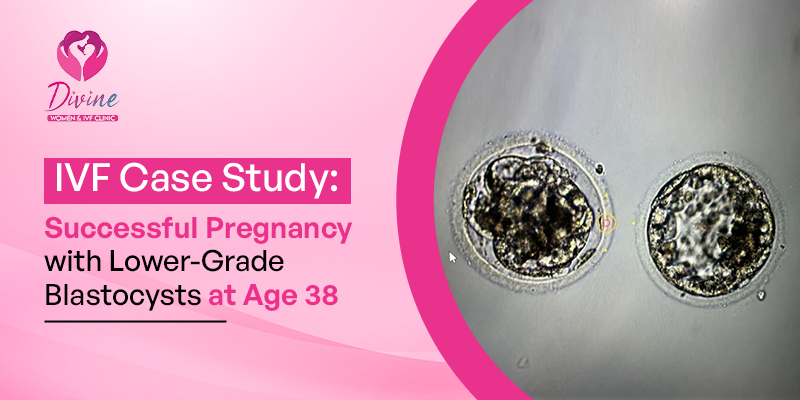
Table of Contents
The first thing that usually catches a patient’s attention after an IVF cycle is the embryo grading report. Couples wait anxiously to hear terms like 4AA, 5AA, or “excellent quality pre-embryo.” When those grades do not appear, disappointment often arrives before the embryo transfer even takes place.
Over the years, Dr. Mandavi Rai has seen many patients assume that a lower-grade embryo automatically means a failed cycle. The reality is often more complex. Embryo grading is useful for embryologists to evaluate development, but it does not convey the full picture of implantation, pregnancy, or live birth potential. This case is an example of that.
The patient was 38 years old and had been attempting to conceive for a few years. When she reached the Divine Women IVF Clinic, she had already tried several fertility treatments and experienced no success. Her medical file was filled with reports, prescriptions, and previous attempts that failed to yield the results she had wanted.
Yet the cycle that eventually led to pregnancy was the one in which the available blastocysts were not considered ideal by conventional grading standards.
The patient presented with a long-standing history of primary infertility. Like many couples, she had started with less invasive treatments before considering IVF. Her treatment history included:
Despite years of treatment, pregnancy had not been achieved. Repeated failures affect more than just treatment plans. Patients begin to question whether another cycle is worth pursuing. They begin to wonder if parenthood will ever happen for them.
When she consulted Dr. Mandavi Rai, an experienced IVF specialist in Noida, the first step was not to rush into treatment. A complete reassessment was performed to understand the situation from the beginning rather than relying entirely on previous reports.
One of the most common pitfalls in fertility treatment is applying a standard protocol to every patient regardless of history. Patients with previous IVF failures often require a more individualised strategy rather than a standard plan.
At the best IVF centre in Noida, the patient’s treatment plan was customised to her age, reproductive history, and clinical profile.
Ovarian stimulation was initiated under close monitoring.
While the cycle progressed smoothly, the final embryo development report presented a situation that many IVF patients find discouraging.
At the end of embryo culture, only two blastocysts were available:
Higher-grade blastocysts generally receive more attention because they are associated with better implantation rates. When lower grades appear on the report, patients often assume the outcome has already been decided.
That assumption can sometimes be misleading. Embryo grading is based on morphology. It assesses developmental characteristics and structural appearance. What grading does not do is provide a guarantee.
A lower-grade embryo can still carry implantation potential. Likewise, a top-graded embryo does not automatically result in pregnancy. This distinction became extremely important in this case.

Despite the challenges, the outcome was positive. The patient conceived successfully during her very first IVF cycle at Divine Women IVF Clinic. Pregnancy was confirmed through clinical testing, and a follow-up ultrasound at six weeks revealed:
For a patient who had spent years moving through different fertility treatments without success, this positive result represented a significant milestone in her journey to parenthood.
One of the most valuable lessons from this case is that IVF success cannot be predicted by embryo grading alone. Many patients view embryo grades as a final verdict, but reproductive medicine frequently reminds us that biology does not always follow expectations. Despite:
This result reinforces that implantation is influenced by multiple clinical factors, not embryo grade alone.
Even a good embryo requires a receptive uterine environment to implant successfully. A well-prepared endometrium can make a meaningful difference in treatment outcomes.
Embryo transfer is not simply a procedure. It is a carefully timed event designed to align embryo development with the implantation window.
Culture conditions, embryo handling, incubation systems, and embryology expertise all contribute to the overall viability of embryos.
One of the most challenging aspects of fertility treatment is that no two patients respond identically. Clinical predictions provide guidance, but individual biological variation often influences outcomes in ways that cannot always be anticipated.
This is why an experienced IVF specialist in Noida looks beyond embryo grades and evaluates the complete clinical picture before making treatment decisions.
When patients get reports of lower-quality embryos, many of them give up on IVF. While the concern is understandable, this case demonstrates why grading should be viewed as a guide rather than a guarantee.
Important takeaways include:
Most importantly, this case reminds patients that fertility treatment should be based on possibilities, not assumptions.
Multiple IVF or IUI cycles may lead to emotional burnout and frustration. However, each cycle provides information that may help optimise future treatment strategies.
Women’s natural fertility decreases as they get into their late 30s. This is a situation where careful treatment planning and individualised care are essential.
Many patients think that lower-quality embryos won’t work. This case illustrates that embryo morphology is just one of many factors that affect implantation.
The uncertainty of infertility treatment can affect emotional well-being. Honest counselling and realistic expectations help patients navigate the process with greater confidence.
A successful implantation is influenced by the quality of the embryo, how receptive the uterus is, the timing of the transfer, and individual fertility factors.
This case demonstrates that IVF success is not always about having the highest-graded embryo. Sometimes, it is about having the right clinical strategy, the right timing, and the right team guiding your treatment. If you have experienced failed IVF cycles , unsuccessful IUI attempts, or are struggling with infertility after 35, consult Dr. Mandavi Rai. She is a trusted IVF specialist in Noida, helping you understand the treatment options available for your unique situation. At Divine Women IVF Clinic, every case receives personalised attention, advanced fertility care, and evidence-based treatment planning designed to maximise every viable opportunity. Schedule a consultation with Dr. Mandavi Rai to receive a detailed fertility assessment and personalised treatment guidance.
Also Read: IVF Success at 40 Through PGT-A and Advanced Genetic Testing
Yes, although higher-grade embryos generally show better implantation rates, lower-grade blastocysts can still lead to successful pregnancies and healthy births.
Not necessarily. Many lower-grade embryos retain implantation potential and should be evaluated within the context of the patient’s overall clinical situation.
A previous failure does not automatically predict future outcomes. In many cases, treatment modifications and individualised planning can improve results in subsequent cycles.
The experience of the clinical team, laboratory quality, personalised treatment planning, and patient counselling can all influence IVF outcomes. Working with an experienced IVF specialist in Noida can help patients make informed treatment decisions.
Embryo grading is important, but it is only one factor among many. Endometrial receptivity, embryo-endometrium synchrony, laboratory expertise, and patient-specific factors all contribute to success.
 Book An Appointment