Get Online consultation with 3 Easy Process
- Pay Consultation Fee (RS.1000) by using QR Code
- Send payment screenshot on whats app: +91 9910873175
- After Verifying Your Payment, We Will connect you with doctor

Table of Contents
Parenthood means something different to everyone, but for those who have been trying for years, it becomes the only thing that matters. Many IVF cycles do not succeed because of the wrong treatment, but because of one step that gets missed along the way. Today, with the right clinical approach applied at the right time, women above 40 are achieving their successful pregnancies, and Anuradha’s case is real proof of that.
Here we’re going to discuss a real case study of Anuradha, who was 40, had been dealing with secondary infertility for 8 years, and had already gone through multiple failed treatments before she walked into Divine Women IVF Clinic. What happened next was not a miracle. It was the result of a very specific clinical decision made by Dr. Mandavi Rai, the best IVF doctor in Noida, to test the embryos genetically before transfer.
Anuradha came to Dr. Mandavi Rai after 8 years of secondary infertility. She had conceived naturally once before but had been unable to do so again despite multiple treatment attempts elsewhere. Her husband’s test results were normal, so the focus fell on her age and egg quality.

Dr. Mandavi Rai planned an IVF cycle with specific attention to age-related risks. Anuradha responded well to ovarian stimulation:
But this is exactly where many IVF cycles take a wrong turn. Good morphology, but the way an embryo looks does not tell you whether its chromosomes are normal.
Given Anuradha’s age, Dr. Mandavi Rai recommended preimplantation genetic testing for aneuploidies, referred to as PGT-A. This test involves taking a small cell sample from the embryo and checking it for chromosomal abnormalities before transfer. Embryos that come back chromosomally normal are called euploid embryos.
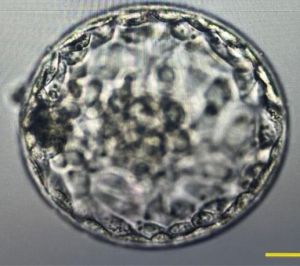
Two of Anuradha’s four blastocysts were sent for biopsy. One came back euploid. That single euploid embryo was transferred. The result was a confirmed positive pregnancy. Beta-hCG came back at approximately 400 mIU/mL, which is a strong early pregnancy reading. And in the first attempt, it was one embryo and a positive result.
“At advanced maternal age, it’s not just about good embryos, it’s about genetically healthy embryos.” This case brings a few things into focus that are worth understanding clearly.
There are several factors that can affect IVF outcome, and understanding these challenges helps patients approach the process with realistic expectations.
From the above case, you must have understood that Anuradha’s outcome was not luck; it came from the right clinical decision that most IVF cycles skip. If you have been through failed attempts or are starting your IVF journey above 40, the right step is to book your consultation with Dr. Mandavi Rai. With more than 15 years of experience, she provides personalised fertility treatments supported by advanced IVF technology and a patient-specific approach. Reach out to our Fertility clinic in Noida and understand what your options actually are.
Also Read: IVF Egg Retrieval in Noida: Procedure, Timeline & What to Expect
Yes, though the protocol has to be planned carefully based on the individual. Age brings specific challenges, but as Anuradha’s case shows, a well-designed approach can still lead to a positive outcome in the first attempt itself.
It checks whether the embryo has the correct number of chromosomes. An embryo that passes this test is called euploid, and that is the one with a real chance of resulting in a healthy pregnancy.
Yes, many patients at fertility clinics come in with exactly this history: we have one child, and we have been trying for years, but there is no success. In these cases, with the right diagnosis and treatment plan, IVF works well.
Always choose the best IVF doctor in Noida who gives you a diagnosis that is specific to you, not a generic plan. Dr. Mandavi Rai has 15+ years in reproductive medicine and over 3,000 successful IVF cycles and more importantly, she takes the time to understand each case before recommending anything.
 Book An Appointment
[…] Also Read: IVF Success at 40 Through PGT-A and Advanced Genetic Testing […]
[…] Also Read: IVF Success at 40 Through PGT-A and Advanced Genetic Testing […]